I didn't get out once last week. No backpacking or camping. No fishing or day hiking. It was a slow week in the world of outdoor adventuring. Its funny but now when I have those slow weeks, I feel guilty, like I'm not doing enough. I tell myself, "Its just a week", but it doesn't work. I cant shake the feeling that I'm cheating myself. So for today's blog a mix of flowers seen on the trail in the last month or so. Enjoy.
My trip to Reavis Ranch in the Superstition Wilderness got off to a rough start. Having received the Osprey Xenith pack during the week, I was really looking forward to testing it on the trail, but it wasn't meant to be. After I filled the pack with gear, I found that I could not get a comfortable fit. I paced around the house for an hour making adjustments and feeling it out, but to no avail. I think the torso size may be off, even though it's a medium just like my regular pack. Needless to say, at the last minute I switched packs, not wanting to risk hiking 20 miles in a pack that is causing me pain in the "try on" phase.
My other problem didn't really present itself until I was on the trail. Last Tuesday on a day-hike, one of the insoles in my Merrell Moab's ripped somehow. Procrastinating during the week, I didn't buy a replacement pair of insoles until the last minute. Consequently, within a quarter mile on day one, I got a blister. Considering I have never had a blister in this pair of shoes, I recognized immediately that it was being caused by the new insoles, that may or may not have needed a break-in period. At first, I opted to just cover my heels in mole-skin and keep the insoles, thinking that as I walked the insoles would form to my foot better... Big mistake. By the half-mile mark I was limping from the pain on my heels. I finally took out the insoles, but it was too late, I already had a nickle-sized blister on my right heel. But my feet felt much better without the insoles, so I covered the blister in fresh mole skin and pressed on.
The Hike
Reavis Ranch Trail
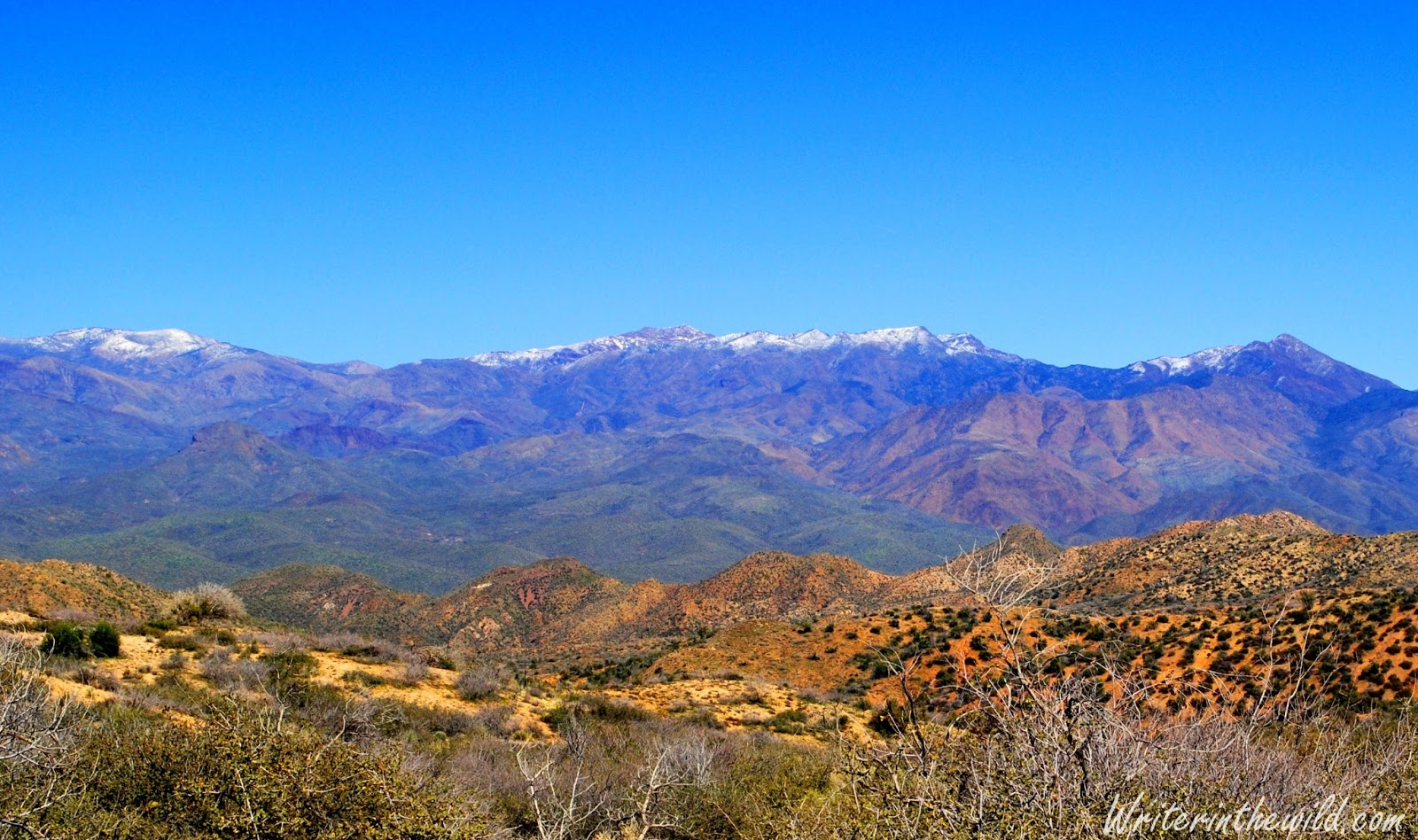
Reavis Ranch Trail 109 heads south from a beautiful trail-head overlooking Apache Lake. The hike starts out in typical desert fashion with plenty of sand, rock, and cacti, but quickly changes. This area of the Superstitions is so unlike the Superstitions I'm used too. Its less rocky, less rugged, and filled with plant life I would normally associate with being further north. The gentle grade slowly climbs over grass covered hillsides that offer excellent views of the Superstition mountains and beyond. In fact, I would say the first 3/4 of the 10 mile hike into Reavis Ranch is basically one long ridge walk. There wasn't much shade up there, but the wind did a great job of making the hot day bearable.
Engelmann's Hedgehog
Although not as dramatic as my Cave Creek trip, everywhere I looked wildflowers were blooming. I saw poppies, scarlet gilia, cactus flowers and many more. And the insect life was busy too. I saw butterflies, caterpillars, beetles, and a ton of ants. In fact I haven't seen so many ants before. I swear there were at least 20 colonies on that stretch of trail.
The Superstitions
We reached a pass about halfway in, and on the other side, the mountains were covered in trees! I almost felt like I was back in Washington, especially when we reached Reavis Ranch, where I actually pitched my tent among some pines. It wasn't just pine trees either. There was an entire apple orchard down there, and the trees were all in bloom. It was very beautiful.
Apple Blossom
We spent the rest of the afternoon relaxing in the breeze and exploring Reavis Ranch. Elisha Reavis was a pioneer who built a ranch down here in the late 1800's, where he grew vegetables and fruit. He apparently lived a solitary life, spending his days gardening and hunting. All that's left now is the ruins of his ranch and his apple orchard that still produces fruit. Researching for this blog I found an old obituary. It just illustrates what I love about Arizona... The history! Here is an excerpt.
Elisha M. Reavis 1827-1896 "Hermit of Superstition Mountains" Found dead
from the Star by the Arizon Sentinal, Yuma, Az. May 16, 1896
"Old Man Reavis, the Hermit of the Superstitions" is dead. His body, Half eaten by coyotes, was found last Thursday near his hut in the superstition Mountains, twelve miles north of the Silver King Mine. Whether death was natural or violent is only a matter of conjecture; also the time when it might have occurred, for the hunger of the wolves had not left enough evidence upon which to base an opinion. Of all men as widely known, there was none in Arizona whom so little was known as "Old Man Reavis". Much has been written about him by the few who have visited in his mountain home but it was generally produced by the imagination of the writers. It is said that the old recluse was driven into exile by a disappointment in love, but he never said so and nobody else has been found who could have known the facts..."
That night we saw lots of mule deer in the grass near our camp. I took some photos, but they were just too far away to come out any good. We did spot a short-horned lizard on the way out Sunday. It's actually the second one I've seen since moving to Arizona, and like the first one, it didn't move a muscle, thinking it was camouflaged. They are the neatest little lizards, covered in spines along its back like a dinosaur, but totally calm and relaxed and seemingly pretty docile.
Short-horned lizard
It was a great trip. Other than my feet (which actually took quite a pounding on the rocky trail without insoles), I felt like I could go another 20 miles when we reached the car on Sunday. I'm just chomping at the bit to do a longer trip. I've been looking into The Highline Trail below the Mogollon Rim, and I think its something I'm going to try to accomplish sometime this year... possibly June? The trail is about 53 miles long end-to-end and I would like to thru-hike it in one shot. Anyway, I'll let you know once I'm in the planning stages. Thanks for reading.
The amount and variety of wildflowers in the desert right now is incredible. I've shot so many flowers in the last couple weeks, and I wanted to share some with you. The top 3 shots were taken at Bartlett Lake. The last shot was near Cave Creek.
Okay, I will admit the title of today's blog post is misleading, as our "Easter camp-out" ended up an "Easter day trip". I couldn't have imagined that so many people would have the exact same idea. By the time we reached Bartlett Lake early Saturday afternoon it was much too late. The multitudes had already arrived. Their tents and RV's packed so tight that even if we found a spot (which we didn't) it would have been right on top of someone else. So we set up a nice little spot on the beach at Rattlesnake Cove (no camping allowed) instead. The water was surprisingly warm, and with a little help from my friends, I quickly got over the disappointment of not finding a camp. So our Easter camp turned into a pleasant day playing at the beach.
I have decided Spring time must be the best time for desert hiking. I've hiked along Cave Creek between Seven Springs and Spur Cross before, and frankly there isn't much color to see; just a dead sea of drab. But in the Spring everything is different... Everything is growing... The flowers are blooming. The sea of drab is now a variety of browns and greens, and the California Poppy has painted the hillsides gold. It is a beautiful sight indeed.
Climbing into the Cave Creek trail system.
We started on the Skunk Tank trail with a little climbing. A slight breeze kept the scorching sun at bay. Not that we have reached summer temps yet, but just hiking under direct sunlight minus any shade can be tough (at least for a north-man like myself). But the wind was nice, and we made short work of the climbs. My new friend Dave Creech (aka Wilderness Dave) came along for the trip, and I had a fun time picking his brain. The talk was mostly about blogging and photography, and It made for some really cool conversation.
Enter the poppies
Things turned serious really quick when we hit the poppy fields. The wildflowers were everywhere, and they turned the hills gold. It made for some excellent photo opportunities.
Covered in poppies
Golden hills near Cave Creek
Eventually, after a little backtracking, we found a camp for the night. It was a pretty grass-covered spot on the banks of Cave Creek. The water was clear and blue and delicious, and it was surrounded by gold-painted poppy-covered hills. It was all very beautiful.
Cave Creek camp
Opposite direction view of Cave Creek near our camp.
It was an excellent, but short trip. I am always grateful to get out backpacking, even if its only an overnighter. The wildflowers really add a whole new dimension to desert hiking, and I encourage everyone to get out right now and enjoy them while they are in full bloom. They truly are a beautiful sight, and my photos don't really do the scene justice.
I tried out the Sawyer squeeze filter for the first time. It worked as advertised, but I haven't developed an overall opinion yet, so keep an eye out for the review sometime down the road.
Also used the Solo Stove again. Worked awesome. I'll have a review for it later this week.
One last note, I did manage to slip on a rock and fall in the creek during one of our many crossings on the way out Sunday. I kept my feet underneath me, so I only got wet up to the knees, but it could have been disastrous, as I had my Nikon on my hip, in the camera bag, with the lid ajar for easy access.
Somewhere along the line I decided I needed to lug a dSLR into the backcountry with me. My old point-and-shoot wasn't cutting the mustard. I would return from a backpacking trip and upload a bunch of crappy photos that I wasn't happy with. I needed a camera that would capture what I was looking at as accurately as possible. Enter the Nikon d3000. I took some shots around the house. I bought "Nikon d3000 for Dummies". I was determined to haul it with me, but I didn't know how. Its big, bulky, heavy, and fragile, and not very conducive to backcountry travel. After a trip to REI I returned home with the M-Rock Yellowstone camera bag.
This camera bag is the perfect size for my Nikon, with an attached 18-55mm lens, but it doesn't leave much room for anything else. The camera fits securely upside-down in the bag. It would probably fit a slightly bigger lens, say a 55-200mm, but anything bigger than that would be pushing it. It has pockets on top and in front, that I usually carry a few cleaning supplies in. I usually carry a small plastic bag folded up at the bottom of the camera bag to cover the camera in case it rains. Although it does come with an attached stuff sack, I found it pretty much worthless.
My biggest challenge initially was figuring out the best way to carry the bag. It comes with two shoulder straps, and there are six different ringlets on the bag to hook the straps to for a variety of configurations. Eventually I found that the most efficient method is to hang the bag across my body over one shoulder. For stability I buckled the belt of my backpack over the top of the camera bag strap. This way the camera hung at my hip like a six-shooter, and was easy to draw if I needed it fast.
On my hip, lid propped open.
As easy as it is to reach the camera, carrying the bag this way did come with some challenges. First, the way the bag is designed the lid opens from back to front (see above photo). The zipper is stiff, and with the camera pressed against my body, its nearly impossible to open. What I had to do was just leave the zipper unzipped (unless its raining). There is a buckle on top that will still securely fasten the lid, and its much easier to open then fighting the zipper. The other problem I have, is that over time the shoulder strap will hurt my shoulder. I found that the only way to deal with this problem is to switch shoulders every couple hours.
With this configuration I used the M-Rock Yellowstone to carry my Nikon into the backcountry for the next 3 years. Over time I really developed a love/hate relationship with it. The constant pressure on my carrying shoulder can be a huge annoyance, especially on long days. Also, the carabiners on the ends of the strap are complete junk. At least a dozen times since I've been using this bag, a carabiner has mysteriously worked its way open. Imagine my surprise as I'm walking down the trail, and all of the sudden my camera bag falls in the dirt. It happens way too often, but also brings me to the best thing about this bag...
It protects the camera. Its been rained on, snowed on, and dropped countless times over the years, and the camera has always remained unscathed inside. If protection is your primary concern when buying a camera bag for hiking and backpacking, then definitely consider the M-Rock Yellowstone. Although the bag is not water proof, it is water resistant, and has protected my camera in sustained rain. I cant convey enough how much of a beating this bag has taken over the years, and it shows. Threads are pulling out everywhere. The zipper is coming apart. The material in the back is disintegrating. But it still works, and I still use it.
Takes a licking.
Overall this bag has served its purpose. Its near bomb proof and will keep your camera safe. The problem is that some of the components are cheap, and the bag itself isn't comfortable to carry with a backpack.
I was able to get out camping again this week, and I had a really great time thanks to beautiful scenery and excellent company. We camped right on the beach in this little cove on Bartlett Lake, and for the most part we had the place to ourselves. The lake is ringed by some really cool green rock formations, and surrounded by brown mountains and giant saguaros.
Water level was high. Notice the fire ring?
This trip was all about fishing. So far my Arizona fishing experience has resulted in zero catches, but this time I managed to reel in at least one bass. It was small, and I threw it back, but it was better than nothing that's for sure. It was really cool camping on the beach because we could just fish from our camp.
James trying to land a lunker.
We did see plenty of wildlife. Lots of lizards and turkey vultures, a hawk, a great blue heron, and a couple roadrunners that boogied by our camp. Unfortunately most were too far away to get a good shot with my current lens.
Roadrunner
Hitchhiker
Overall it was a really fun trip, but I wished I could have stayed out a bit longer, and I wish I would have caught more fish, but its just being out there that is the most important thing for me. I'm already thinking about my next destination.
It seems Spring has arrived to the desert. I've never seen more color on the trail then I have in the last couple weeks. The landscape actually looks green!
Engelmann's Hedgehog cactus.
Teddybear Cholla
I don't know why this Cholla is called "Teddybear". You definitely would not want to hug this cactus.
Earlier this week I wrote a blog about my old stomping grounds, The Dishman Hills. Well, it got me thinking about another place I really love to hike in Spokane, The Iller Creek Conservation Area. This spot is a little more of a drive than Dishman Hills, but not much. Its got a great 5 mile loop that passes through some thick forest all the way up to the Rocks of Sharon overlooking the Palouse. Its a really cool spot. One of my favorite things about it is that no matter how nice and sunny and mild the weather is, the area around the Rocks of Sharon is extremely windy. Anyways, I wanted to share some photos I had, and a short video. Enjoy.
One of the Rocks of Sharon. You can see the Palouse in the background.
I remember when I lived in the shadow of the Dishman Hills in Spokane. It gave me the ability to be on the trail in just a few short minutes of walking out the door. That was the beauty of Spokane living: lots of parks in town, with great hiking and beautiful scenery. Whether its Beacon Hill or Riverside State Park, there are places to escape too without a long drive out of town. My spot was always Dishman Hills though. As a kid I used to go up there to explore with my friends. We would climb the water tower, catch frogs and snakes at one of the ponds, or play Army in the woods. I vividly remember finding an old American Flag up there. It was worn out, faded, and weather beaten, but I could still recognize the stars and stripes. I was convinced that a battle must have been fought there back in the "olden" days.
There was about a 10 year period where I didn't step foot in the Dishman Hills. I was too busy being 20-something. I didn't hike nearly as much. I moved a lot. But when I was introduced to backpacking a few years ago, I was reintroduced to the Dishman Hills. It became my spot again. I explored the old familiar places and discovered a bunch of new ones. I hiked all the trails, bagged all the "peaks", and explored all the ravines. I explored off trail a lot too, and sometimes found myself accidentally trespassing on private property, or momentarily lost in some unfamiliar place... But it became mine again.
It's funny how when you spend time in a place... When you love a place... It starts feeling like it belongs to you. You feel responsible for it. You take ownership of it.
It started for me in Dishman Hills simply by picking up garbage. I hate seeing trash in the woods, and in the Dishman Hills its almost an epidemic. Usually this trash comes in the form of piles of beer cans and bottles of booze. I've seen it all over Dishman Hills. Illegal fire rings littered with beer cans. Or abandoned camps strewn with ruined gear, and (you guessed it) empty beer cans. The culprits are usually vagrants. In the summer the homeless will sometimes live in the nooks and cranny's of the park. Normally I wouldn't really care... I feel sorry for the homeless, and the woods can offer some shelter and privacy for them... I get it, I really do. The problem is that they have no respect for the woods. They don't just build a camp, they trash the place. I know, because I've seen it. Iv'e picked up lots of trash from vagrant camps, and I'm sure trail crews from The Dishman Hills Conservancy have as well.
Last year, late in the winter, I was hiking in the Dishman Hills on a particularly cold morning. There was frost on the ground, and barely any hikers at all in the park that day. I kept hearing banging in the woods. It sounded like hammering... Like somebody working on something. I followed the sound off trail, and from a hilltop spotted a man building a lean-to. He looked to be in his mid-40's. He wore faded black slacks and a black jacket. I stood in silence watching him, trying to decide what to do. My first reaction was just to turn back and forget it, but I was pissed off because I had seen so many empty abandoned camps full of trash. This was actually the second time I had come upon a man in the woods building a shelter, but the first time I just walked away. This time would be different.
"You're not supposed to be building shelters out here you know" I said rather forcefully from about 20 feet behind him. This of course scared the hell out of him because I totally sneaked up on him without him realizing it. He finally spotted me on the hilltop.
"Who are you? The conservation police?" he replied.
"No, but I care about conservation, and I care about this park." I said.
"I'm just making a good spot to have breakfast and relax in the woods" he said.
"That's fine" I said, "but you shouldn't be tearing down trees to do it." The guy seemed really nervous. His eyes kept darting back and forth from me to his backpack. I didn't believe his story for a second.
"What, are you going to call the police?" he asked. Of course I didn't want to call the police because I felt bad for this guy, and I knew that he was probably homeless.
"If you need a place to stay there is a mission downtown. I can give you a dollar for the bus." I said. He seemed offended that I suggested he was homeless.
"I'm not homeless. I have an apartment. I just like to stay in the woods sometimes. Is that a crime?" he said.
"The problem is that I see camps like this all the time around here, and thy're always full of garbage and empty beer cans." I said.
"I'll clean up after myself I promise. And I wont tear down any more trees." he replied.
I could hear the desperation in his voice, and besides, I had no authority over this man at all. I just wanted to let him know that there were people who used the park that actually cared about the park, so maybe he would think twice about leaving a mess.
"Okay, that works for me." I said, and I walked away.
I was compelled to speak up in that situation because Dishman Hills was my spot, and I had a stake in its condition. I couldn't just do nothing, because I felt responsible. I think that's why conservation groups try to push people to play outside so much. Because they know that if you love the place, then you might love it enough to protect it.
Firefighter putting out a brush fire I spotted off trail in Dishman Hills.
I left my spot last June when I moved to Phoenix, but I quickly found a new spot. The Phoenix Mountains Preserve is 10 minutes from my house, and I usually get out there twice a week. I don't know it like I know the Dishman Hills, but I am learning. I try a different route every time I go. I connect different trails to make a different loop every time. I climb all the peaks and explore all the out-of-the-way places. I love it. I love having a place that I know better than any other. Sure, its right in the center of town, but so what? Its outside and its in nature, and its my spot. Whats your spot?
My first camping trip of the year in the books. Its one of the bonuses of living in Arizona; you can camp and backpack year round. This trip was strictly car-camping, with a little bit of hiking and fishing mixed in. We camped about 100 yards from the beach on Theodore Roosevelt Lake (which is actually a reservoir) in Tonto National Forest. It was a beautiful camp with great lake views, and surrounded by barren desert peaks, the highest among them covered in snow.
Roosevelt Lake camp
I wish I could report that I caught a bunch of fish, but unfortunately I was skunked, which seems to be occurring with more frequency the older I get. In fact this was the second trip in a row I didn't catch anything. Luckily the trip up to Tonto National Monument was a huge success. The impressive cliff dwelling were built from siltstone in a huge cave by the Silado peoples around 1300 AD.
Lower ruins - Tonto National Monument
Unfortunately I could not get the picture I wanted. From this angle the light wasn't right, and the Park service is very strict about keeping people on trail, so I couldn't photograph it from a different direction. But still, I wanted to show you what the ruins look like, because they are just really cool.
Close-up of a room in the lower ruins
The lower ruins have 19 rooms. The much bigger upper ruins boast 40, but the park strictly controls access to it. The only way to see it is by a Ranger guided tour, and you have to make reservations in advance. From the photos I've seen of the upper ruins, it would definitely be worth the extra effort to see them.
View of Roosevelt Lake from the Lower Ruins trail.
Roosevelt Lake is the biggest lake entirely within the state if Arizona, but like I mentioned before, its actually a reservoir created by damming the Salt River. Its crazy how much we humans can alter the earth's landscape, but as much as I dislike it, I cant help but be impressed with what we can accomplish.
Roosevelt Dam (lakeside view)
Overall it was fun trip. Car camping can be a really good time, but I cant help but long for a little more solitude. Hopefully I can get out backpacking soon. Sarah and I are talking about a possible backpack/or camping trip in Saguaro National Park this weekend. Either way I am always happy when I can get away from the city and enjoy the peace of mind that one can only get from the outdoors.